

Introduction
It is the basic right of investors to select the platform that offers the best yield. Imagine that your bank does not attract you anymore due to its uncompetitive interest offering. You open an account in another bank with better interest rates. Take this analogy to decentralized finance (DeFi) protocols instead of banks and you will be able to understand what cross-chain DeFi is. Blockchain interoperability can hardly be epitomized better than cross-chain DeFi.
DeFi for Beginners
DeFi is a finance system built on blockchain technology capable of running without any intermediaries like banks, brokers or centralized exchanges. In the absence of any third party, blockchain technology runs on programs that intelligently supervise and validate transactions. These programs are called smart contracts. Cross-chain crypto world is as enticing as any other financial landscape.
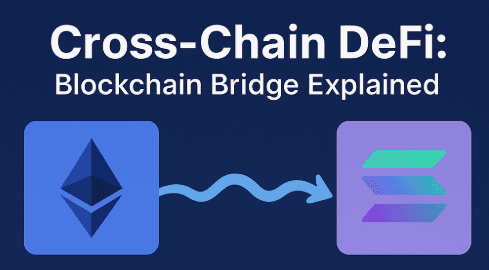
Cross-Chain DeFi: Blockchain Bridge Explained
Cross-chain DeFi simply means taking your crypto assets from one blockchain to another in search of the better yield. Yield farming 2025 has seen revolutionary developments in the decentralized finance. Cross-chain DeFi bridges like Wormhole, Avalanche, Polygon make this interoperability possible. Of these, Wormhole is also an Ethereum to Solana Bridge The movement from one blockchain to another allows investors to diversify risks. Moreover, they can explore emerging protocols and maximize their returns. Investors get the option to multiply opportunities by becoming a part of the unified crypto and blockchain space.
Why Use Cross-Chain DeFi?
The rise of Solana blockchain during the past two years has rewarded investors beyond their expectations. In such a situation, one might ask the rationale of going from pillar to post by switching chains. Maximizing the gains is not the only reason behind exploring cross-chain DeFi. There are other incentives, too.
You can avail yourself of lower fees and more efficient execution by using cross-chain DeFi. Usually new projects offer this kind of incentive. Due to less congestion on the network, transactions are confirmed way faster than on the busy networks like Ethereum and Solana.
Cross-chain DeFi allows you to test, explore thoroughly and provide feedback to the developers. They may add you to their community as a reward for the liquidity you provide and the interest you take by testing and exploring their network.
As of latest statistics, more than $200 billion are locked on different DeFi protocols. Such a large liquidity is not evenly spread. So cross-chain DeFi is an opportunity to hunt the best liquidity.
As blockchain interoperability improves, and as more bridges and protocols support multiple chains, it becomes easier and more efficient to move assets. Structural growth and network effects offer significant attraction to explore cross-chain DeFi.
How You Can Use Cross-Chain DeFi
If you are interested to reap maximum benefits out of your DeFi experience, you may want to try cross-chain option. The process is quite simple as you can go through the following steps.
1. Add Crypto to Your Wallet
Sign up on a non-custodial wallet like Trust Wallet, Phantom, Metamask, etc. Do not forget to save the private keys or seed phrases as loss of these details means loss of funds. Make sure that the wallet supports the cryptocurrency you want to use. Next, add the funds to the wallet.
2. Use a Bridge to Move Crypto
In the preceding paragraphs, we have mentioned the networks that serve as Bridges between different blockchains. You can use any of these to move your assets across different blockchains. Typically, the source chain contract locks your asset (or burns it), and, on the target chain, a corresponding token is minted or unlocked. Make sure you specify the correct destination chain, asset, and you understand the fees and time involved.
3. Earn Rewards
You can earn rewards in many different ways on blockchains. A few of these means are yield-farming in a liquidity pool, lending out stablecoins, and staking in a protocol. You can also earn via trading fee on a few protocols. The yield varies widely from one network to another.
Why 2026 Is the Year for Cross-Chain Dominance
Although DeFi on-chain has been going on for years, maturation of interoperability infrastructure has only happened in 2025. Keeping in view the progress cross-chain DeFi has made, analysts predict that even better times are coming for it in 2026. During the preceding few years, a few bridge hacks were tested, but to an unpleasant end. The most important landmark, therefore, has been the emergence of new generation of secure, robust, and decentralized bridges has emerged.
2025 also has witnessed a few major upgrades in blockchain networks like Ethereum and Solana. Ethereum Pectra upgrade in May 2025 and proposed Fusaka upgrade in December is all set to make Ethereum more powerful and more scalable. Upgrades in Layer-2 protocols like Arbitrum, Optimism and Polygon will make the whole ecosystem attractive for DeFi users.
Also, Solana also experienced a compute-unit upgrade named SIMD-0286. Its ecosystem and tooling enhancements such as Pinocchio” library, “Surfpool” local simulation tool, Solana Attestation Service (SAS) are set to further enhance the user and developer experience. Solana DeFi opportunities are almost as lucrative as those in Ethereum.
The Explosion of Tokenized Real-World Assets (RWAs) is perhaps the most significant catalyst in improving cross-chain DeFi usage. Everything form US treasuries to real estate is being tokenized. This development is creating a massive demand for yield-generating, low-volatility assets within DeFi. An investor want to generate an efficient DeFi passive income by making a diverse portfolio that contains RWA tokens. These tokens are available on various chains, so investors are induced to cross-chain DeFi by switching the networks. Introduction of new category also brings useful competition and fragmentation of liquidity.
Safety Tips in Cross-Chain Yield Farming
Crypto yield farming opportunity is undoubtedly attractive, but it is imperative for you to follow a few cautions lest you lose your funds when you move crypto between blockchains.
1. Research about the network you want to use. Hacks and scams are very common in DeFi world. Use the social media handles and study people’s opinions by searching for the blockchain in general. Best DeFi Protocols 2026 lists are available on major crypto news sites.
2. Contract address is very important in crypto world. Even a single digit or letter may result in loss of your money. It is advisable to send the minimum allowed amount first to test the network.
3. If possible, try to immediately withdraw the amount you have just sent. There are certain scam networks that only accept the money but then restrict withdrawals.
4. Blockchain and DeFi world is very risky. You should invest only what you can afford to lose.
If you follow these DeFi security tips, you are likely to make the most of this great earning opportunity presenting itself in the blockchain and cryptocurrency world.
Conclusion
Cross-chain DeFi is transforming how investors earn, diversify, and manage their crypto assets. By enabling seamless movement across multiple blockchains, it opens the door to better yields, faster transactions, and wider participation in a unified financial ecosystem. With stronger bridges, upgraded networks like Ethereum and Solana, and the rise of tokenized real-world assets, 2026 is shaping up to be the defining year for cross-chain DeFi. As long as users stay informed, they can take full advantage of this next wave of decentralized financial innovation.
FAQs
What is Cross-Chain DeFi?
Cross-chain DeFi allows investors to move their crypto assets between different blockchains to find the best yields and lower fees. It uses blockchain bridges like Wormhole, Avalanche, and Polygon to make this possible.
Why should I use Cross-Chain DeFi?
Using cross-chain DeFi helps investors access better rewards, lower transaction fees, and faster processing times. It also lets them explore new DeFi projects and diversify risks across multiple blockchains.
Is Cross-Chain DeFi safe?
Cross-chain DeFi can be profitable but carries risks such as scams and bridge hacks. Always verify contract addresses, test with small amounts first, and only invest what you can afford to lose.
This is an educational article and doesn’t intend to promote any blockchain project or its native coin. Always do your own research before investing in crypto.

Umair Younas is a veteran crypto journalist with 6 years of experience. He writes on various categories including Bitcoin ($BTC), blockchain, Web3 and the broader decentralized finance (DeFi) space. He pens well-researched price analysis and prediction articles in addition to credible news articles. He writes easy-to-grasp educational articles to fulfil his aim of creating blockchain awareness.
- Umair Younas

- Umair Younas
- Umair Younas
- Umair Younas